


PRODUCT STRATEGY
TO FIX A FLAWED SEARCH
Search is foundational, specially for a content platform.
When search fails, customers disengage at the exact moment they’re actively looking for something — eroding trust, retention and brand value. Our search was broken. I created a search strategy to fix it and build an experience that supports customer missions across our platforms.


Problem
01
Search functionality is unreliable and error prone
Across our web platforms, 31–48% of sessions end in immediate failure, while only 31–55% are efficient
Our paid-for apps aren't doing much better, with 60% efficient success and 40% of sessions involving friction or failure.
02
Engagement with search on web is low
Only 7–15% of web sessions include a search.
"Just cancelled my subscription. Was fed up with the search mechanism never responding... I'm looking for muffin recipes and the 4th item is Yorkshire Puddings followed by Mushroom Burgers!"
Research
Research goals
I created a research strategy to build a clear understanding of our key brands’ customer missions and journeys. This was critical to building a defensible product strategy focused clearly on customer needs.
Insights
A shift in customer understanding
The assumption was that users arrived knowing what they were looking for — ready to type a query and retrieve a result. The data told a different story.
Mission type
GF
RT
Discovery (low-intent)
~70%
~74%
Retrieval (High-intent)
~30%
~26%
Opportunity
The customer journey
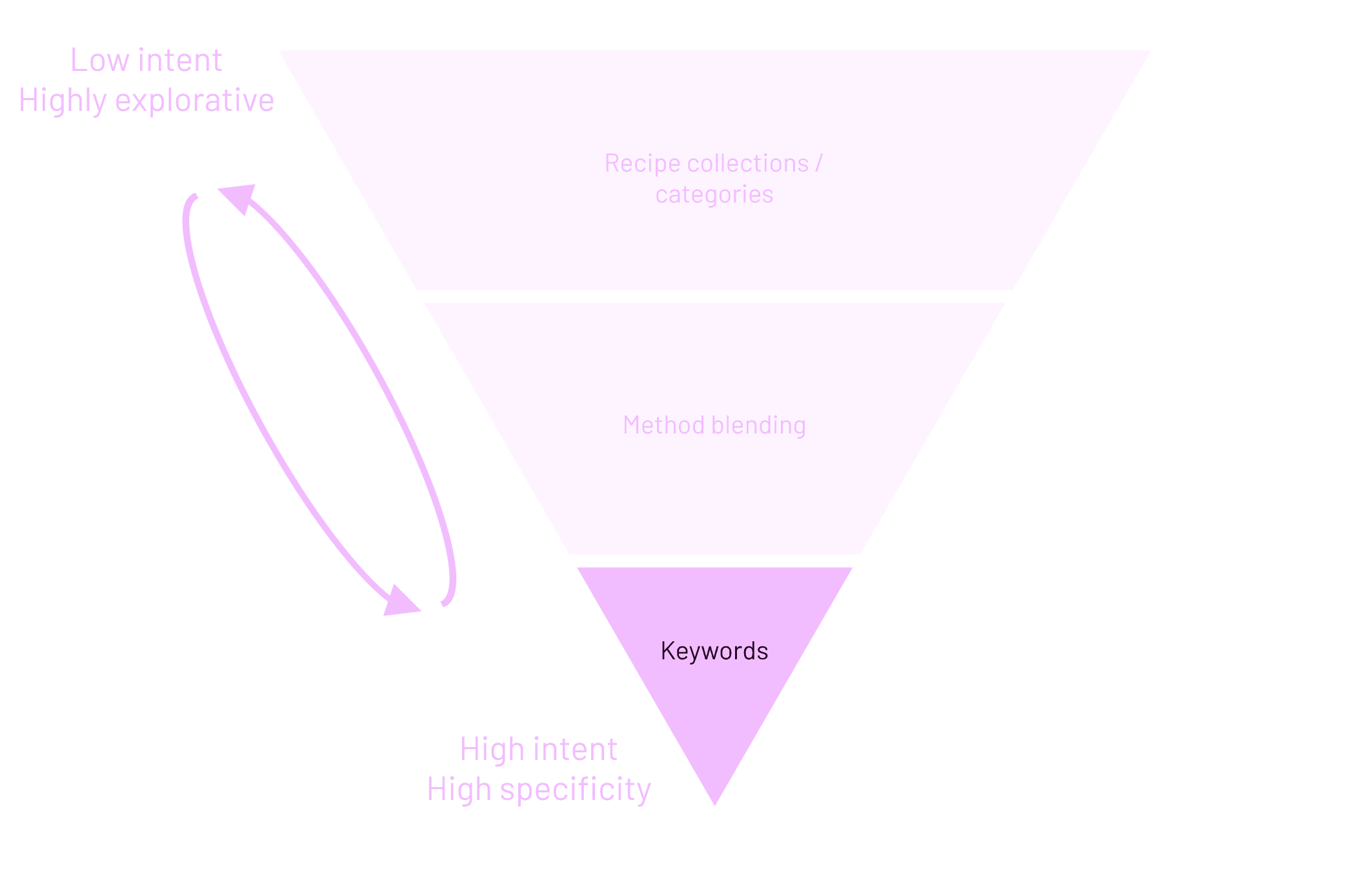
Survey insights show users don't arrive ready to search.
Discovery missions start with browsing collections and categories — mechanism that best support low-intent constraints — and narrow down as their intent builds.
Keyword search only enters the picture once intent has crystallised enough to form a query. For the majority of users, that point is never reached.

Friction
Where search fails customers
I asked customers rank statements from highly disagree to highly agree.
Issue
GF
RT
Too many results to sort through
6.4 / 10
6.4 / 10
Difficulty deciding between options
5.6 / 10
5.7 / 10
No results matching intent
5.6 / 10
5.7 / 10
Search doesn't understand intent
4.7 / 10
5.4 / 10
Confidence in result ranking
4.9 / 10
5.1 / 10
4 key insights
An adaptive search
The research then surfaced four key that directly shaped the product strategy:
Product strategy
I worked with the PM to translate findings into a prioritised roadmap built around 4 strategic areas.
Our analytics data showed poor engagement with the search feature overall, so increasing engagement became a prerequisite for the other key initiatives.
