

AI SUPPORTED
DISCOVERY
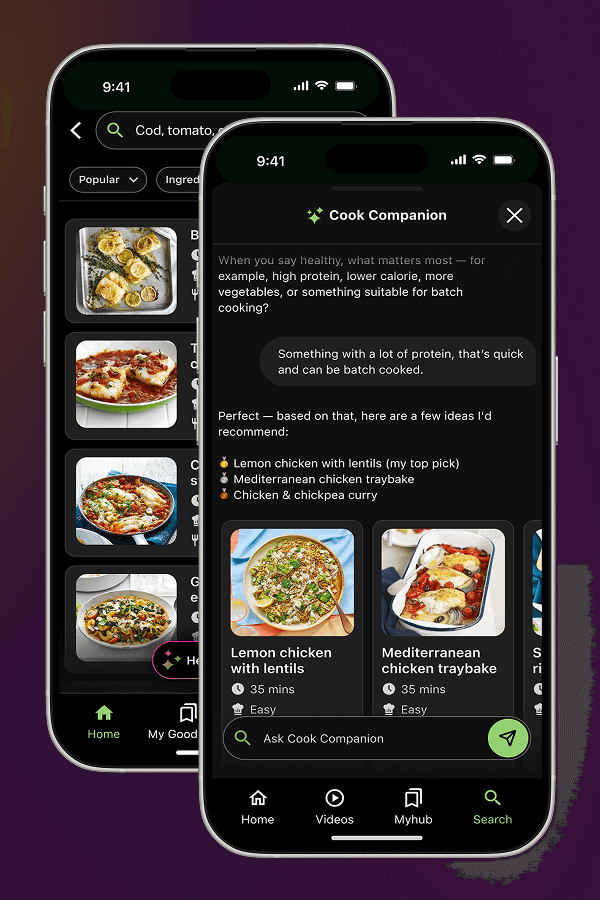
We created an adaptive search experience for the Good Food app, that supports customers' discovery needs by intelligently routing to an AI Cook Companion chatbot or traditional search.

Problem
My research highlighted a change in user habits
78% of customers say they use AI to find and discover recipes with 62% explicitly using AI chatbots — suggesting that new discovery behaviours were forming outside recipe platforms including Good Food.
A deeper problem
Chatbots aren’t just helping customers discover recipes; they’re supporting customers across the entire cooking journey.
●
Before cooking: 78–83% use AI for recipe discovery and deciding what to cook.
●
During cooking: 55% use AI for problem-solving and recipe adaptation.
And only 23–28% say they cross-check AI suggestions against a recipe platform.
Key threats
How customers use Chatbots
Most prompts included constraints, often ingredients, but varied considerably in intent and uncertainty.
Customers say chatbots often narrow their options too quickly and make assumptions about their needs. This raised the question of whether chatbots are the best response for every discovery prompt.
Hypothesis
Search remains an important content-discovery tool, and Chatbot isn’t always the best response to a discovery query.
Testing real customer prompts
Using the exact customer prompts captured in the earlier research, I ran two studies: a text-only card sort followed by a study showing prototypes of all three responses — to understand whether customers expected Search, chatbot conversation or a chatbot AI summary — to best support each query.
Insights
Most users expect an adaptive experience while only 25–28% consistently preferred traditional Search.
01
Chatbots are largely expected when prompts are question based or open-ended
02
Constraint led queries favour a traditional search experience
03
When clear constraints are paired with uncertainty, it produces a more nuanced picture.
03
AI summary was nearly always expected for problem solving prompts
Opportunity
Enhancing search, not replacing it.
Both traditional search and chatbots are key mechanisms supporting various customers' discovery needs.
We will retain Good Food's existing search to provide quick and easy access to a range of relevant recipes, while introducing a chatbot experience to support customers who need guidance both with building their intent and evaluating options to make a decision.
This is a real opportunity for Good Food to provide an experience customers expect and value, which is adaptive and not a one-size-fits-all approach.
Good Food's well placed to bridge the experience gap
Technical
feasibility
Is query routing possible and can it reliably meet our needs?
I built a search router that isolates word classifications, identifies and scores intent signals which determine the likelihood of a follow-up question. Together these values determine which type of experience is best for the customer.
The logic behind the router is configurable, so as we progress this can be iterated and refined.

An adaptive search flow
Routing
One entry point routes users towards the experience that best supports their mission. Queries signalling a need for guided support are routed to Cook Companion chatbot.
Conversation discovery
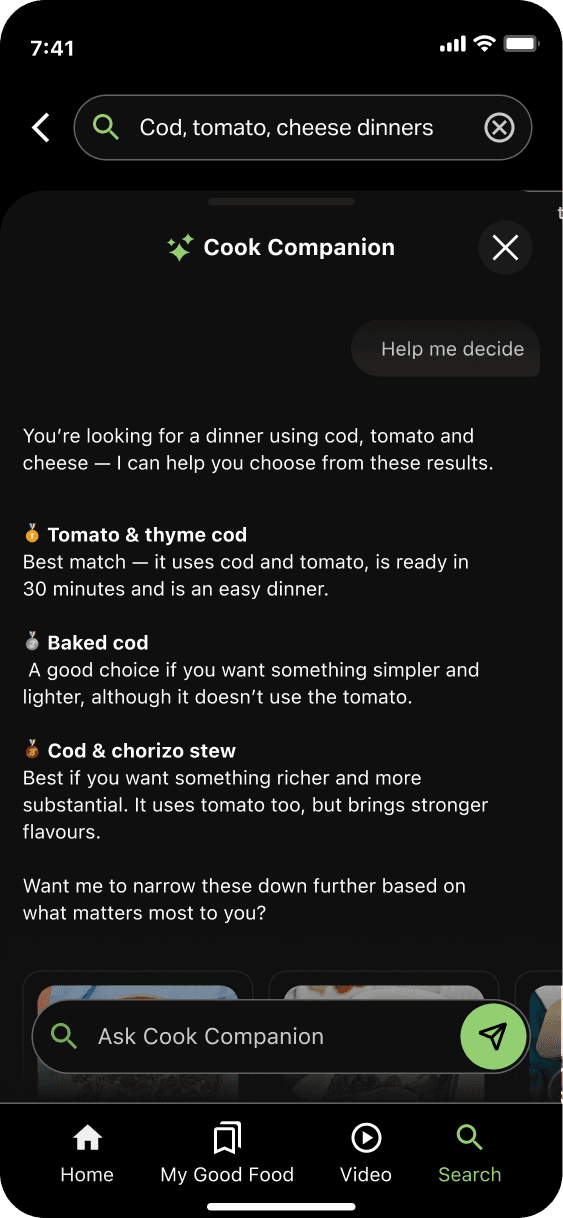
For now, there are two ways to enter the Cook Companion chatbot, when queries are routed there or when users explicitly ask for that support through 'help me decide' action.
Conversational experiences aren’t for everyone, so we’re selective about which queries are routed to Cook Companion, while always giving users the freedom to return to Search.
Traditional search
A small majority of queries point towards the existing search flow, but with a small but significant improvement — helping users decide with an entry point back into Cook Companion.
AI summary
Problem solving queries always route to Cook Companion, but instead of guiding user, a summary provide a resolution for the customer problem.

Chatbot
Working closely with engineers, we created conversation patterns to guide the chatbot as it builds intent and narrows options, helping us create a consistent and reliable conversational system that works across different levels of discovery intent.
Tone of voice
‘Trusted Friend in the Kitchen’ is what the Good Food brand is trying to build across all of its content, and extending this into the conversational experience is key to creating a consistent brand experience.
Response types
Not every query needs a back-and-forth. Where a question can be answered directly, chatbot responds with a short summary. Where more exploration is needed, it opens into a full conversation.


Customers often struggle when deciding which recipe to choose from a long list. A “Help me decide” button gives them access to Cook Companion at the point where support is needed, helping narrow the results into a smaller set of relevant recommendations.



Success
There are four types of session outcomes: immediate failure, iterative failure, iterative success and immediate success.
Chatbots are naturally iterative. While aligning our success measures with traditional search, our goal is for over 80% of sessions to result in iterative success.
The product is due to enter its pre-release phase.
